Anxiety and Brain Fog Solving Both Aniracetam
If you've ever found yourself caught in the exhausting cycle of mental fog and creeping anxiety, you're far from alone. These two conditions have a habit of showing up together — and that's no coincidence. There is a precise biochemical reason why brain fog and anxiety are so deeply intertwined, and understanding that relationship is the first step toward addressing both at the root level. Emerging research and decades of clinical observation are pointing toward a remarkable nootropic compound called aniracetam — a non-addictive, orally bioavailable molecule that may offer a genuinely effective alternative to the pharmaceutical approaches that have left millions of people feeling like shadows of themselves.
Why Brain Fog and Anxiety Always Show Up Together
It's not your imagination. Brain fog and anxiety are biochemically linked, and that connection runs deep into the architecture of your nervous system. At the center of this relationship are two key brain structures: the amygdala and the prefrontal cortex. The amygdala is your brain's threat-detection center — it processes fear and initiates your stress response. The prefrontal cortex, by contrast, is your rational command center, responsible for decision-making, focus, and emotional regulation.
When glutamatergic (excitatory) and GABAergic (inhibitory) signaling fall out of balance, the amygdala can become hyperactive while the prefrontal cortex loses its ability to keep things calm and clear. The result? You feel simultaneously wired and mentally sluggish — anxious yet unable to think clearly. This is not a character flaw or a willpower issue. It is a measurable neurological imbalance that deserves a precise, science-informed solution.
The Problem With Conventional Anxiety Treatments
The standard medical response to anxiety typically involves benzodiazepines or psychiatric medications — drugs that carry a significant burden of side effects. These include addiction potential, sexual dysfunction, emotional blunting, and cognitive suppression. For tens of millions of people, these medications don't resolve the underlying problem — they simply muffle it, often at a steep neurological cost.
One of the most troubling consequences of long-term use of certain psychiatric medications is their documented negative impact on neuroplasticity — the brain's ability to form new connections, adapt, and essentially grow. Neuroplasticity is not a luxury. It is the biological foundation of learning, memory, emotional resilience, and recovery. When that capacity is diminished, the brain becomes less capable of healing itself over time, which means the solution becomes part of the problem.
This is precisely why researchers and clinicians studying cognitive enhancement have turned their attention toward nootropic compounds that work with the brain's natural architecture rather than suppressing it.
What Is Aniracetam?
Aniracetam is a synthetic nootropic compound belonging to the racetam family and is classified as a pyrrolidinone derivative. It was developed in the early 1970s and has been studied extensively for its cognitive-enhancing and anxiolytic (anti-anxiety) properties. Unlike many pharmaceutical interventions, aniracetam is not a controlled substance in most countries and does not carry the addiction profile associated with benzodiazepines.
What makes aniracetam particularly compelling is its dual-action profile: it simultaneously addresses anxiety and cognitive performance — two conditions that, as we've established, are biologically connected. Research has shown reductions in anxiety symptoms of approximately 45% in subjects using aniracetam, without the characteristic zombie-like suppression or dependency risks associated with conventional anxiolytics.
Importantly, aniracetam is orally bioavailable in its standard form. Unlike peptide compounds that are degraded in the digestive tract before reaching systemic circulation, aniracetam survives the gastrointestinal environment and enters the bloodstream effectively when taken correctly — a distinction worth understanding for anyone researching nootropic administration routes.
How Aniracetam Works at the Neuronal Level
To appreciate what aniracetam actually does, it helps to understand how neurons function at a fundamental biological level. Neurons are not abstract or mystical — they are cells, and metabolically speaking, they are extraordinarily expensive to run. The brain accounts for roughly 2% of total body weight yet consumes approximately 20% of the body's total energy output in the form of ATP. Each individual neuron demands a remarkable share of that energy just to maintain its resting state.
Aniracetam works primarily at the neuronal membrane level. Neuronal membranes are composed of lipid bilayers, with two key phospholipids playing dominant structural and functional roles:
- Phosphatidylcholine — critical for membrane integrity and acetylcholine synthesis
- Phosphatidylethanolamine — essential for membrane fluidity and cellular signaling
These phospholipids are not merely structural scaffolding. They actively govern the viscosity, fluidity, and permeability of the neuronal membrane, all of which directly influence how efficiently neurons communicate with one another. When membrane fluidity is optimized, neurotransmitter receptor sensitivity improves, and ion channel function — the mechanism through which electrical signals travel between neurons — becomes more precise and efficient.
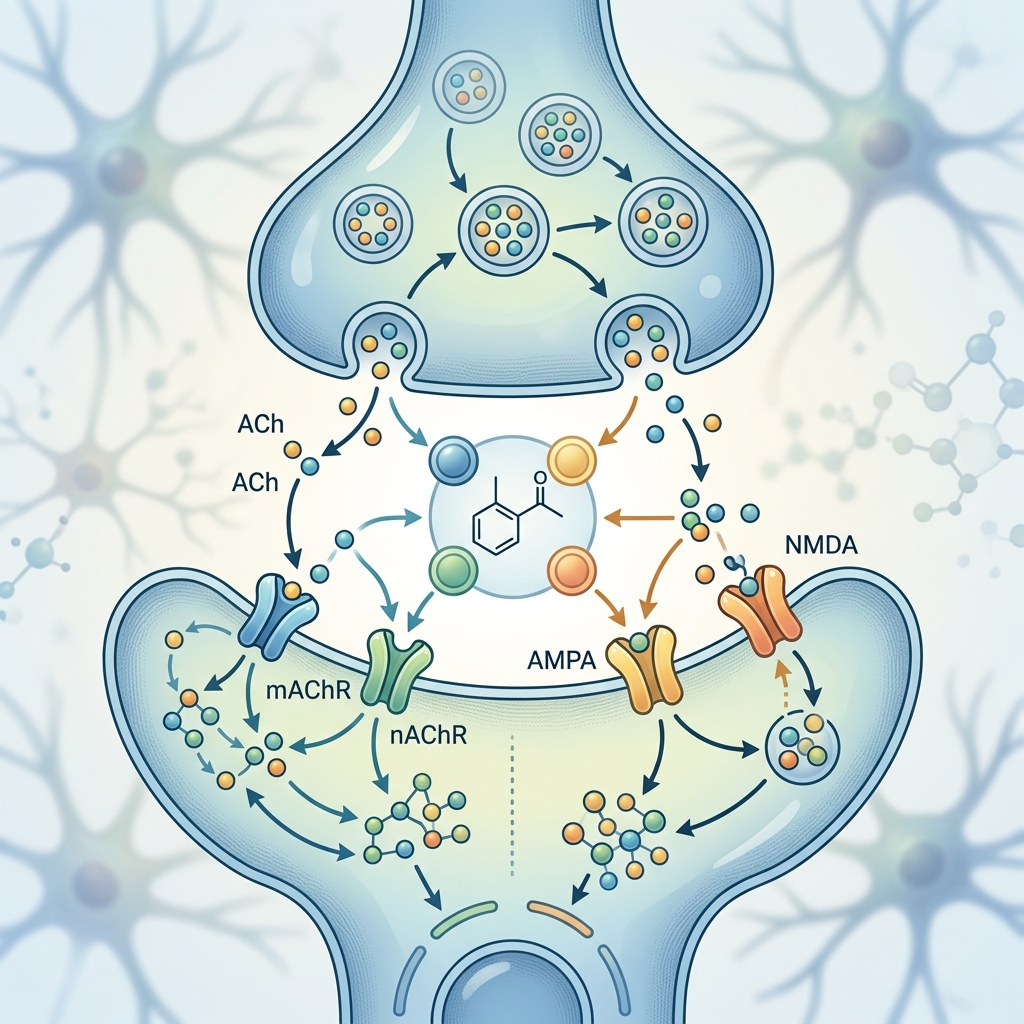
Aniracetam is believed to modulate AMPA receptors (a subtype of glutamate receptor), which are central to synaptic plasticity and fast excitatory neurotransmission. By positively modulating these receptors, aniracetam can enhance signal transmission without overstimulating the system. It also influences cholinergic signaling, which plays a key role in attention, learning, and memory consolidation.
The Anxiety-Cognition Connection Explained
When neuronal membranes lose their optimal fluidity — due to poor diet, chronic stress, aging, or inflammatory processes — receptor sensitivity declines. This degraded communication environment contributes to both cognitive sluggishness (brain fog) and dysregulated emotional processing (anxiety). The brain is essentially operating on a compromised network.
Aniracetam's membrane-level activity helps restore the signaling environment that allows the prefrontal cortex to reassert its regulatory influence over the amygdala. The result is a brain that is simultaneously calmer and sharper — not sedated, but genuinely more balanced. This is the mechanistic explanation for why users consistently report improvements in both anxiety levels and mental clarity when using aniracetam appropriately.
Important Considerations for Use
Research consistently highlights that proper administration protocol matters enormously with aniracetam. Because it is fat-soluble rather than water-soluble, aniracetam must be taken with a source of dietary fat to be effectively absorbed. Taking it without fat significantly reduces bioavailability and can lead to the mistaken conclusion that the compound isn't working.
Typical research dosing protocols involve split dosing — usually twice daily — to maintain stable plasma levels throughout the day, as aniracetam has a relatively short half-life of approximately one to three hours. Consistency in administration is key to observing meaningful benefits over time.
As with all nootropic research compounds, individual biochemistry plays a role in outcomes. Stack considerations — particularly combining aniracetam with a choline source such as alpha-GPC or CDP-choline — are commonly discussed in the research community to support the cholinergic demands that racetam compounds can place on the system.
Key Takeaways
- Brain fog and anxiety are biochemically linked, rooted in imbalanced glutamatergic and GABAergic signaling between the amygdala and prefrontal cortex.
- Conventional anxiety medications carry significant risks including addiction, cognitive suppression, and reduced neuroplasticity over time.
- Aniracetam is an orally bioavailable nootropic compound from the racetam family, developed in the early 1970s and studied for both anxiolytic and cognitive-enhancing effects.
- Research suggests aniracetam may reduce anxiety symptoms by approximately 45% without the dependency or sedation profile of benzodiazepines.
- Aniracetam works at the neuronal membrane level, improving membrane fluidity through its effects on phospholipid bilayers, which enhances neurotransmitter receptor sensitivity and ion channel efficiency.
- It modulates AMPA receptors and supports cholinergic signaling, contributing to improved synaptic plasticity, attention, and memory.
- Fat-soluble administration is critical — always take aniracetam with dietary fat for proper absorption.
- Pairing aniracetam with a choline source (such as alpha-GPC) is widely recommended to support optimal results and reduce potential headaches from cholinergic demand.
- As with all research compounds, individual results vary and proper protocol adherence significantly impacts outcomes.
Disclaimer: This content is for educational and informational purposes only and does not constitute medical advice. Aniracetam and related nootropic compounds are sold for research purposes. Always consult with a qualified healthcare professional before beginning any new supplement, compound, or wellness protocol. Do not discontinue prescribed medications without guidance from your physician.
Shop Featured Peptides
Explore high-quality research peptides. Use our referral link to support independent research.