Is Long-Term Methylene Blue Use Safe
Is Long-Term Methylene Blue Use Safe? A Deep Dive Into Mitochondrial Energy and the Science of Cellular Performance
Methylene blue has rapidly become one of the most discussed compounds in the biohacking and longevity research space — and for good reason. This article breaks down exactly how methylene blue supports mitochondrial energy production, why chronic fatigue is fundamentally a cellular dysfunction, what the research says about long-term safety, and how to use methylene blue alongside critical micronutrients for maximum effect without detrimental consequences.
Why Fatigue Is a Cellular Problem, Not a Character Flaw
Before understanding why methylene blue works, it is critical to understand what fatigue actually is at the biological level. Fatigue — whether physical, cognitive, or emotional — is not laziness. It is not a personality trait. It is a dysfunctional biological state rooted in cellular energy failure.
The overwhelming majority of people who suffer from chronic fatigue remain stuck because they are treating the symptom — the tiredness itself — rather than the underlying cause: a breakdown in the body's ability to produce adenosine triphosphate (ATP). ATP is the universal energy currency of every cell in the human body. Every single function — thinking, moving, fighting infection, building muscle, regulating hormones — requires ATP. When ATP production is compromised, everything downstream fails simultaneously.
The human body contains approximately 37 trillion cells, every one of which is continuously converting fuel — glucose, fatty acids, and amino acids — into ATP through a process called oxidative phosphorylation. This is widely considered the most efficient energy production system in known biology. When it breaks down, the consequences are systemic and profound.
How the Electron Transport Chain and Proton Gradient Generate ATP
To appreciate what methylene blue does inside the cell, you need a foundational understanding of how mitochondria generate ATP. Think of the mitochondria as a hydroelectric dam. Electrons (the "water") flow through a series of protein complexes — Complex I, Complex II, Complex III, and Complex IV — embedded in the inner mitochondrial membrane. This flow releases energy that specialized proteins use as a mechanical pump.
This pump does something elegant: it takes protons (hydrogen ions) from inside the mitochondrial matrix and forces them into the narrow intermembrane space between the inner and outer mitochondrial membranes. This creates a massive chemical imbalance — a high concentration of protons in the intermembrane space and a depleted concentration in the matrix. This is the proton gradient, and it is essentially your mitochondria's battery voltage.
The protons can only return to the matrix through one specific protein complex: ATP synthase. ATP synthase is not a simple pump — it functions as a nanoscopic rotary motor, physically spinning as protons flow through it down the concentration gradient. This mechanical rotation compresses ADP (adenosine diphosphate) and an inorganic phosphate molecule together, forming ATP (adenosine triphosphate). This process is called chemiosmosis.
The steepness of the proton gradient directly determines the rate of ATP production:
- Steep gradient: Fast, abundant ATP production → sustained energy, mental clarity, emotional stability, robust immune function
- Flat gradient: Slow or minimal ATP production → fatigue, brain fog, immune collapse, depression, hormonal dysregulation
This single insight — that the proton gradient is the body's master battery — explains why so many seemingly unrelated symptoms occur simultaneously in chronically fatigued individuals. They all share the same upstream cause.
The Three Systemic Failures That Destroy Mitochondrial Function
There are three core biological failures that systematically destroy the electron transport chain and collapse the proton gradient. Understanding these is essential before adding any compound — including methylene blue — to a protocol.
1. Systemic Inflammation
Chronic inflammation doesn't merely cause discomfort — it physically damages the proteins that comprise the electron transport chain. Inflammatory cytokines including TNF-alpha and IL-6 alter and degrade the protein complexes of the ETC. This "rusts the turbines," jamming electron flow and collapsing ATP output. Addressing the root sources of chronic inflammation — poor diet, gut dysbiosis, environmental toxins, chronic infection — is a prerequisite for restoring mitochondrial function.
2. Insulin Resistance
When cells become insulin resistant, glucose cannot enter them efficiently. Without adequate glucose or fatty acid availability, the electron transport chain slows dramatically because there is no fuel feeding electrons into the system. This is analogous to trying to run a hydroelectric dam with no water source. Insulin sensitivity is foundational to mitochondrial performance.
3. Mitochondrial Nutrient Deficiency
The electron transport chain requires specific micronutrients to function. Without these raw materials, the system cannot build ATP regardless of fuel availability. This is where most people miss the boat entirely. The critical mitochondrial support nutrients include:
- CoQ10 (Ubiquinol): The electron shuttle between Complex I and Complex III. A 2015 study published in the Journal of the American College of Cardiology found CoQ10 deficiency present in 40% of people with heart failure — a direct result of ETC dysfunction.
- Magnesium: A required co-factor for ATP synthase itself — the spinning turbine. A 2018 study in the journal Nutrients found magnesium deficiency present in approximately 50% of the general population, meaning half of all people cannot spin their ATP turbines properly.
- NAD+ (Nicotinamide Adenine Dinucleotide): The primary electron donor that feeds electrons into Complex I. Research published by Harvard scientist David Sinclair in 2016 demonstrated that NAD+ declines by approximately 50% between ages 20 and 60, progressively depleting ATP production capacity as we age.
- Iron: Required for the function of Complex I, Complex III, and Complex IV. Iron deficiency stalls the electron transport chain. Ferritin levels (stored iron) should always be assessed alongside serum iron when evaluating iron status.
- B Vitamins (methylated forms — B2, B3, B5): These are the precursors for FADH2 and NAD+, the electron donors that feed the chain. Methylated forms are preferred for optimal bioavailability.
- Selenium and Zinc: Required for antioxidant enzyme systems that protect the ETC from free radical damage during normal oxidative phosphorylation.
Why Standard Medical Treatments for Fatigue Fall Short
The conventional medical approach to fatigue relies heavily on stimulants: amphetamines, modafinil, and caffeine. While not inherently harmful in all contexts, these compounds share a critical flaw — they do not address the underlying energy deficit. Instead, they work by blocking adenosine receptors in the brain.
Adenosine is a byproduct molecule that accumulates as ATP is consumed. When adenosine binds to its receptors, the brain registers fatigue as a signal to slow down and recover. Stimulants suppress this signal without restoring actual ATP production. The fatigue signal is silenced, but the energy deficit persists and often deepens. This is why stimulant dependence tends to worsen underlying fatigue over time — it masks the symptom while the root cause continues to deteriorate.
A genuinely effective approach to fatigue requires restoring ATP production at the source: fixing the electron transport chain, reducing systemic inflammation, correcting insulin sensitivity, and replenishing mitochondrial micronutrients.
How Methylene Blue Supports Mitochondrial Energy Production
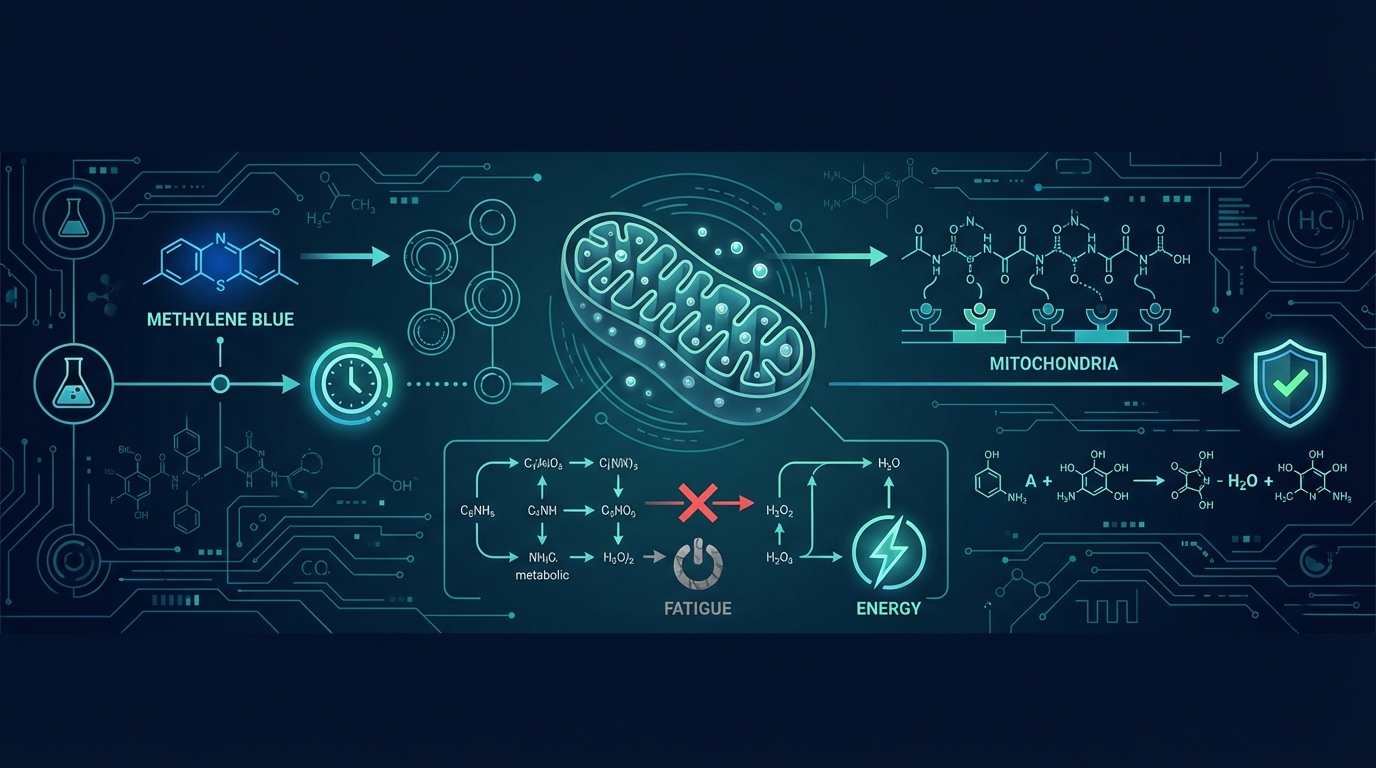
This is where methylene blue becomes uniquely powerful. Methylene blue (3,7-bis(dimethylamino)phenothiazin-5-ium chloride) is a synthetic compound with a fascinating ability to function as an alternative electron carrier within the mitochondrial electron transport chain.
When the ETC is compromised — by inflammation, nutrient deficiency, or oxidative damage — electrons can become "jammed" or leak out of the chain prematurely. Electron leakage is a primary source of reactive oxygen species (ROS), which cause further mitochondrial damage in a destructive feedback loop. Methylene blue interrupts this loop by acting as a redox cycling agent: it can accept electrons from NADH and donate them directly to cytochrome c (an electron carrier between Complex III and Complex IV), effectively bypassing damaged upstream complexes and allowing electron flow — and therefore ATP production — to continue.
This "electron bypass" capacity makes methylene blue especially valuable in states of mitochondrial dysfunction, where damaged complexes would otherwise cause the entire chain to stall. Additionally, methylene blue has demonstrated:
- Neuroprotective effects by reducing mitochondrial ROS production in neurons
- Enhancement of cytochrome c oxidase (Complex IV) activity, accelerating the final step of the ETC
- Improved cerebral blood flow and oxygen utilization
- Potent antifungal and antimicrobial properties
- Potential mood-stabilizing effects via monoamine oxidase (MAO) inhibition at higher doses
Dosing Protocol for Methylene Blue and Mitochondrial Support Compounds
Based on current research and clinical use patterns, the following table summarizes the compounds discussed for mitochondrial support alongside methylene blue. Note that the transcript did not specify precise methylene blue doses, frequencies, or delivery routes beyond general guidance on safe long-term use. All dosing information reflects general research-context ranges used in studies and discussed in the video content.
- Compound: Methylene Blue — Cycle: Long-term use discussed as safe when used properly
- Compound: CoQ10 (Ubiquinol) — Route: Oral (implied)
- Compound: Magnesium — Route: Oral (implied)
- Compound: NAD+ (Nicotinamide Adenine Dinucleotide)
- Compound: Iron — Dose: Lab-guided only — Route: Oral (implied) — Cycle: Not specified; dose based on ferritin levels
Shop Featured Peptides
Explore high-quality research peptides. Use our referral link to support independent research.
